

If you want to improve your website’s rankings, publishing quality content alone is not enough. You also need to understand what other successful websites in your niche are doing. This is where SEO competitor analysis becomes valuable.
SEO competitor analysis helps you discover why competing pages rank well, which keywords they target, how they structure their content, and where they earn backlinks. Instead of guessing what works, you learn from websites that already perform well in search results.
The good news is that you don’t need expensive tools or advanced SEO knowledge to get started. By following a simple process, beginners can identify opportunities to improve their own content and create a stronger SEO strategy.
In this guide, you’ll learn what SEO competitor analysis is, why it matters, and how to perform SEO competitor analysis step by step.
What Is SEO Competitor Analysis?
SEO competitor analysis is the process of studying websites that rank for the same keywords you want to target. The goal is to understand what helps those pages perform well in search results and use those insights to improve your own website.
A competitor analysis does not mean copying another website. Instead, it involves identifying successful SEO practices, finding content gaps, evaluating keyword usage, and improving your pages with unique, more valuable information.
Whether you manage a blog, business website, or online store, competitor analysis helps you make informed decisions instead of relying on assumptions.
Why Is SEO Competitor Analysis Important?
Search engines reward websites that provide useful, relevant, and well-optimized content. If your competitors consistently rank above you, there is usually a reason behind their success.
Performing SEO competitor analysis can help you:
- Discover valuable keywords you may have missed.
- Understand the type of content users prefer.
- Identify opportunities to create more comprehensive articles.
- Learn how competitors organize their pages.
- Find backlink opportunities from trusted websites.
- Improve your overall SEO strategy.
Many beginners assume competitor analysis is only for large businesses or experienced SEO professionals. In reality, even a simple review of a few competing websites can reveal useful ideas for improving your own content. The goal is not to compete with every website online, but to understand what readers expect when they search for a particular topic.
Rather than starting every article from scratch, competitor research provides a clear direction for creating content that better meets search intent.
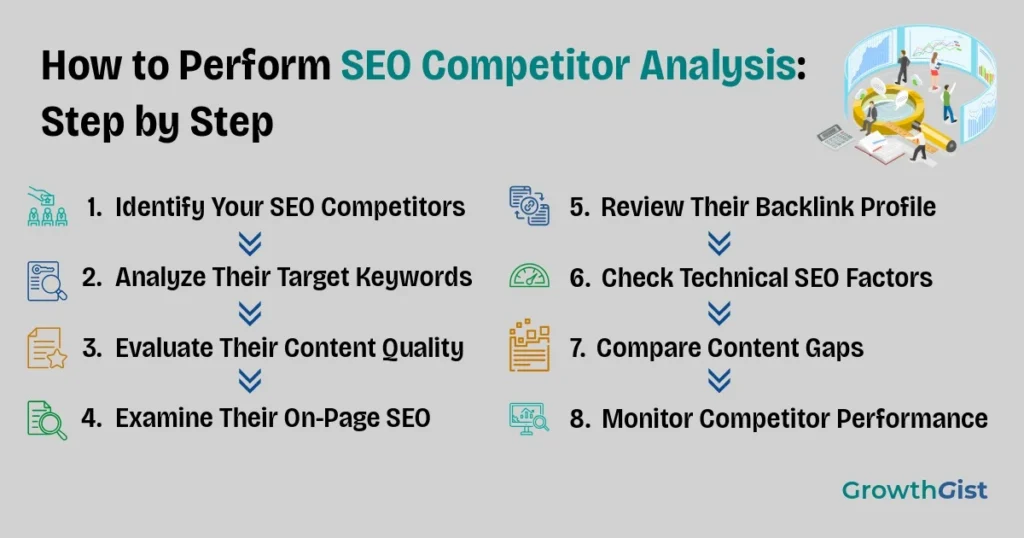
Step 1: Identify Your SEO Competitors
Your business competitors are not always your SEO competitors. A website selling similar products may not compete for the same keywords, while an educational blog could rank for the searches you want to target.
To identify your SEO competitors:
- Search your primary keyword on Google.
- Note the websites appearing on the first page.
- Look for pages with content similar to what you plan to publish.
- Ignore websites with completely different search intent.
Reviewing search results directly in Google Search is one of the simplest ways to identify your SEO competitors.
Create a small list of five to ten competitors. These will become the foundation of your analysis.
Step 2: Analyze Their Target Keywords
Keywords tell search engines what a page is about. Studying competitor keywords helps you understand which topics generate traffic.
Pay attention to:
- Primary keywords used in page titles.
- Related keywords throughout the article.
- Common questions they answer.
- Long-tail keywords included naturally.
Look for keyword opportunities that your competitors target but your own website has not yet covered. These often become excellent ideas for future content.
Remember that keyword research is not about adding as many keywords as possible. Focus on relevance and natural placement.
Step 3: Evaluate Their Content Quality
High-ranking pages usually provide useful information in an organized format.
As you review competitor articles, consider:
- How well they answer the user’s question.
- Whether the information is easy to understand.
- The overall content length.
- Use of examples, lists, and visuals.
- Readability and logical structure.
As you review different websites, you’ll probably notice that every competitor has strengths and weaknesses. Some explain concepts clearly but miss important details, while others cover topics thoroughly but are difficult to read. Observing these differences can help you create content that is both informative and easy for beginners to follow.
📌 Remember
Your competitors are useful sources of insight, not templates to copy. Study what works, then use those ideas to create original content that better serves your audience.
Ask yourself one important question:
How can I create more helpful content for readers?
Your goal is to publish helpful content that adds unique value instead of repeating what already exists.
Step 4: Examine Their On-Page SEO
On-page SEO influences how both users and search engines understand a webpage.
Review elements such as:
- Page titles
- Meta descriptions
- URL structure
- Heading hierarchy
- Internal links
- Image optimization
Notice how competitors organize information and guide visitors through their content. Well-structured pages often provide a better user experience while making it easier for search engines to understand the topic.
Step 5: Review Their Backlink Profile
Backlinks remain one of the strongest ranking signals in SEO. While quality is more important than quantity, understanding where competitors earn links can reveal valuable opportunities.
Look for backlinks from:
- Industry blogs
- Resource pages
- Business directories
- Educational websites
- Guest posts
- News articles
Instead of trying to copy every backlink, identify trustworthy websites that may also be willing to reference your content if it provides value.
Step 6: Check Technical SEO Factors
Even great content can struggle to rank if a website has technical issues.
Observe factors such as:
- Page loading speed
- Mobile responsiveness
- Secure HTTPS connection
- Clean navigation
- Proper indexing
You do not need to inspect every technical detail immediately. A basic SEO audit can help you identify technical issues that may affect your website’s performance. Start by identifying obvious strengths that contribute to a better user experience.
Step 7: Compare Content Gaps
One of the biggest benefits of competitor analysis is discovering content gaps.
A content gap is a topic, keyword, or user question that competitors cover but your website does not.
Content gaps are excellent opportunities to provide additional value for your readers. Instead of trying to write a longer article than everyone else, focus on answering questions that competitors have overlooked or explaining complex topics in a simpler way. Small improvements like these often make your content more useful.
As you compare multiple websites, you may notice:
- Missing beginner guides.
- Outdated information.
- Limited examples.
- Unanswered questions.
- Incomplete tutorials.
Filling these gaps allows you to publish more comprehensive content that better satisfies readers.
Step 8: Monitor Competitor Performance Regularly
SEO is constantly changing. New pages appear, rankings shift, and search trends evolve over time.
Instead of analyzing competitors only once, review them regularly to understand:
- Newly published content.
- Updated articles.
- Changes in keyword targeting.
- Emerging trends within your niche.
Beginners can explore Google Trends to compare search interest and identify emerging topics within their niche.
Regular monitoring helps you stay competitive while keeping your own content current.
Common SEO Competitor Analysis Mistakes
Beginners often make avoidable mistakes when studying competitors.
Some of the most common include:
- Copying content instead of creating original value.
- Focusing only on one competing website.
- Ignoring search intent.
- Looking only at keywords while overlooking content quality.
- Forgetting technical SEO.
- Never updating previous research.
Remember that SEO competitor analysis is an ongoing learning process rather than a one-time task. As search trends and user expectations change, reviewing your competitors from time to time can help you discover new opportunities to improve your website and stay relevant.
Competitor analysis should inspire improvements rather than imitation.
Best Tools for SEO Competitor Analysis
Many tools can simplify competitor research.
Popular options include:
- Google Search
- Google Search Console
- Google Trends
- Ahrefs
- Semrush
- Moz
- Ubersuggest
Free SEO tools are enough to begin learning the process, while advanced platforms provide deeper insights as your website grows.
Final Thoughts
SEO competitor analysis is one of the most practical ways to improve your website without relying on guesswork. By studying successful competitors, you can discover valuable keywords, identify content opportunities, strengthen your SEO strategy, and create pages that better serve your audience.
Use competitor research to understand what already works, then build content that is more accurate, more helpful, and easier for readers to use. Over time, consistent analysis and continuous improvements can help your website compete more effectively in search results.

GrowthGist was founded by Ishwar Solanki to provide clear, practical, and beginner-friendly content on SEO, blogging, AI tools, productivity, website optimization, and digital growth. The platform helps readers build valuable digital skills and strengthen their online presence through actionable insights and reliable information.