
Creating a website is only the first step toward building an online presence. The real challenge is attracting the right audience and providing valuable information that keeps them engaged. This is where content marketing becomes essential.
Instead of relying only on advertisements, content marketing helps businesses connect with people by sharing useful, relevant, and trustworthy content. Whether you run a blog, an online store, or a business website, a well-planned content marketing strategy can help you build authority, attract visitors, and encourage long-term growth.
In this Content Marketing for Beginners guide, you’ll learn what content marketing is, why it matters, the different types of content you can create, and practical tips to get started.
What Is Content Marketing?
Content marketing is the process of creating and sharing valuable content that informs, educates, or solves problems for a specific audience. Instead of directly promoting products or services, the goal is to build trust by consistently providing useful information.
Content can take many forms, including blog posts, videos, guides, infographics, podcasts, email newsletters, and social media posts. Over time, this valuable content helps attract visitors and encourages them to return whenever they need reliable information.
If you’re new to online marketing, understanding what content your audience is searching for is the first step toward creating content that delivers real value.
Why Is Content Marketing Important?
People rarely make decisions after seeing a single advertisement. They often research, compare options, and look for answers before taking action. Helpful content supports users throughout this journey by answering their questions and building confidence.
Content marketing also provides several long-term benefits:
- Builds trust and credibility.
- Attracts consistent website traffic.
- Supports search engine optimization (SEO).
- Improves audience engagement.
- Generates leads and potential customers.
- Increases brand awareness over time.
Unlike paid advertising, high-quality content can continue attracting visitors for months or even years after it’s published.
It’s easy to think that publishing more content automatically leads to better results. In reality, quality matters far more than quantity. A single well-researched article that genuinely helps readers can often create more value than several posts written without a clear purpose. Focusing on usefulness from the beginning lays a stronger foundation for long-term success.
How Content Marketing Works
A successful content marketing strategy follows a simple process:
- Identify your target audience.
- Understand their questions and challenges.
- Create helpful content that answers those questions.
- Publish the content on suitable platforms.
- Promote it through different marketing channels.
- Measure results and improve future content.
Each new piece of content becomes another opportunity to reach people who are searching for information related to your niche.
Types of Content Marketing
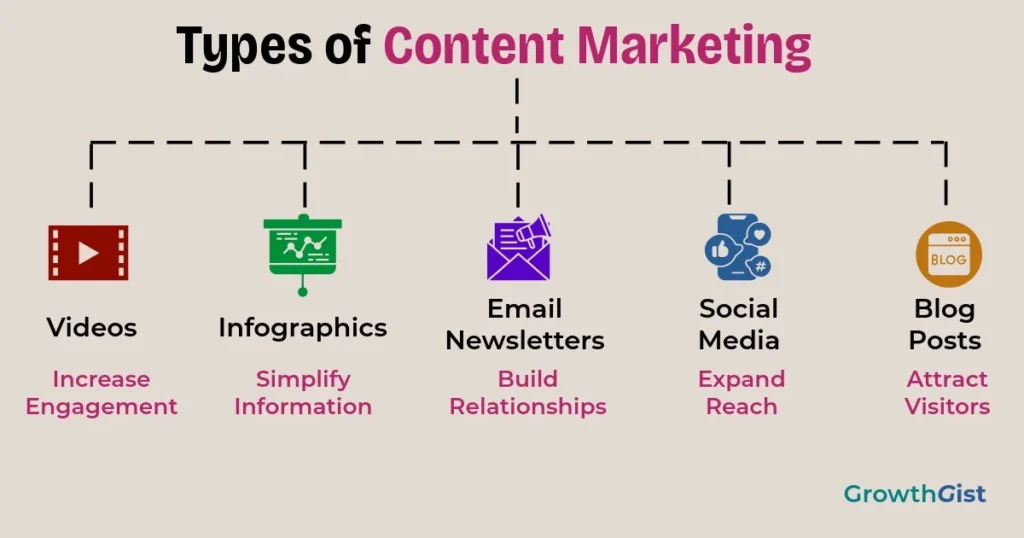
Content marketing includes many formats, and each serves a different purpose. Common content marketing examples include educational blog posts, how-to videos, email newsletters, case studies, and infographics.
Blog Posts
Blogs are one of the most effective forms of content marketing because they help educate readers while improving your website’s visibility in search engines.
A well-written blog post can answer common questions, solve problems, and attract visitors who are actively looking for information. Publishing helpful articles consistently also helps build trust and encourages readers to return for more valuable content.
Videos
Videos are a highly engaging form of content marketing that helps explain ideas in a simple and visual way.
Tutorials, product demonstrations, interviews, and educational videos can make complex topics easier to understand while keeping viewers interested. Sharing valuable videos on your website or social media platforms can also increase audience engagement and encourage people to learn more about your brand.
Infographics
Infographics present information in a visual format, making complex data, statistics, comparisons, and processes easier to understand.
They are especially useful for summarizing key points or explaining step-by-step concepts in a simple and engaging way. Because infographics are easy to share across websites and social media platforms, they can also help increase your content’s reach and attract new audiences.
Email Newsletters
Email newsletters help businesses maintain regular communication with their audience by sharing valuable updates, helpful resources, and newly published educational content.
Unlike social media, email allows you to reach subscribers directly in their inbox, making it an effective way to build long-term relationships. Consistently sending useful newsletters can encourage repeat visits and keep your audience engaged with your content.
Social Media Content
Social media content helps distribute your articles, videos, and other resources to a wider audience while encouraging conversations around your brand.
Sharing valuable content on social media platforms can increase visibility, drive traffic to your website, and help you connect with potential customers. Engaging with your audience through comments and discussions also strengthens trust and builds an active online community.
Choosing the right format depends on your audience, goals, and available resources.
Content Marketing and SEO
Content marketing and SEO work best when they support each other. While SEO helps people discover your content through search engines, content marketing gives visitors valuable information after they arrive.
Creating useful content around relevant topics, understanding user intent, and organizing information clearly all contribute to better search visibility. Publishing helpful articles consistently also strengthens your website’s authority over time.
Rather than treating SEO and content marketing as separate strategies, they should work together to provide a better experience for users.
Although content marketing plays a major role in improving search visibility, it is also an important part of digital marketing as a whole. When combined with SEO best practices, social media, email marketing, and other digital channels, valuable content helps businesses reach the right audience and build stronger relationships over time.
How to Create an Effective Content Marketing Strategy
A content marketing strategy helps you publish content with a clear purpose instead of creating random articles.
Some practical steps include:
- Define your target audience.
- Set realistic content goals.
- Research topics your audience is interested in.
- Create a publishing schedule.
- Focus on quality instead of quantity.
- Update older content whenever necessary.
- Monitor performance to improve future content.
A simple plan helps maintain consistency and keeps your content aligned with your overall objectives.
Successful content marketing strategies help businesses publish useful content consistently while achieving long-term marketing goals.
Content that genuinely helps readers is more likely to be shared, remembered, and trusted.
Common Content Marketing Mistakes
Many beginners focus on publishing more content without considering its usefulness. Avoid these common mistakes:
- Writing only for search engines instead of readers.
- Ignoring audience needs.
- Publishing inconsistent content.
- Skipping keyword research.
- Using misleading headlines.
- Not updating outdated articles.
- Forgetting to promote published content.
Small improvements made consistently often produce better long-term results than publishing large amounts of low-quality content.
Best Practices for Content Marketing
Following a few proven practices can improve both content quality and user experience.
- Create original and helpful content.
- Answer real questions clearly.
- Use simple language that readers understand.
- Organize articles with proper headings.
- Include relevant examples where appropriate.
- Keep information accurate and up to date.
- Maintain a consistent publishing schedule.
- Focus on solving problems rather than selling.
These simple content marketing tips for beginners can gradually improve both user experience and long-term results.
Successful content marketing begins with creating valuable content, but it also involves planning, publishing, promoting, and continuously improving your content over time.
🚀 Quick Tip
Every successful website starts with consistent content creation, but improvement doesn’t stop after publishing. Review your articles regularly, update outdated information, and learn from your audience’s feedback to keep your content useful over time.
How to Measure Content Marketing Success
Publishing content is only part of the process. Tracking performance helps you understand what is working and where improvements are needed.
Some useful metrics include:
- Organic traffic
- Page views
- Average time on page
- Bounce rate
- Keyword rankings
- Backlinks
- Email subscriptions
- Conversion rate
Reviewing these metrics regularly helps you create more effective content in the future.
Tools like Google Analytics make it easier to understand how visitors interact with your content and identify opportunities for improvement.
If you’re just getting started, don’t feel pressured to master everything at once. This content marketing guide is designed to help you understand the fundamentals first. As you continue learning and experimenting, you’ll gradually discover what works best for your audience and build a strategy that supports your long-term goals.
Final Thoughts
Content marketing is more than publishing articles or posting on social media. It is a long-term strategy for building trust, answering questions, and creating meaningful connections with your audience.
Instead of trying to produce large amounts of content quickly, focus on creating information that is accurate, useful, and easy to understand. As you continue publishing valuable content consistently, your website can gradually attract more visitors, strengthen its authority, and support sustainable online growth.

GrowthGist was founded by Ishwar Solanki to provide clear, practical, and beginner-friendly content on SEO, blogging, AI tools, productivity, website optimization, and digital growth. The platform helps readers build valuable digital skills and strengthen their online presence through actionable insights and reliable information.