
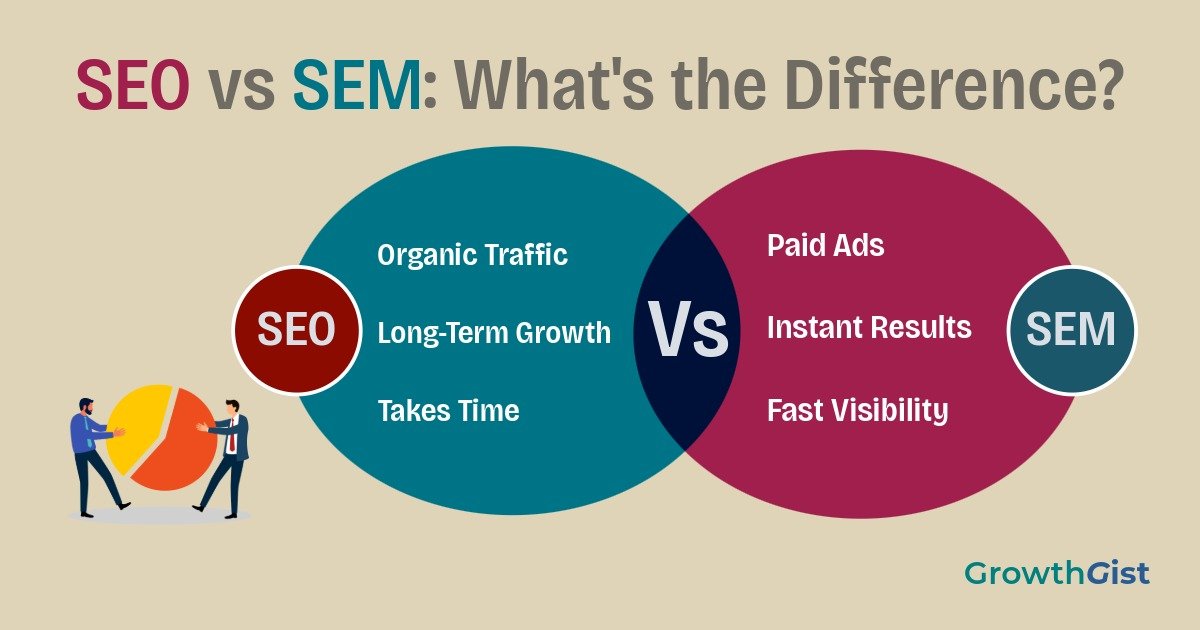
SEO vs SEM is one of the most common comparisons beginners come across when learning digital marketing. While both help websites gain visibility in search engines, they work in different ways and serve different goals.
If you’re new to digital marketing, you’ve probably come across the terms SEO and SEM. Although they are often mentioned together, they are not the same. Understanding the difference can help you choose the right strategy for your website, business, or blog.
Both methods aim to increase visibility in search engine results, but they achieve that goal in different ways. While one focuses on earning organic traffic over time, the other relies on paid advertising for immediate exposure.
In this guide, you’ll learn what SEO and SEM mean, how they differ, and when each approach makes the most sense.
What Is SEO?
SEO, or Search Engine Optimization, is the process of improving a website so it can appear higher in the organic (unpaid) search results. Instead of paying for every visitor, SEO focuses on making your content valuable, relevant, and technically optimized.
A common mistake beginners make is expecting SEO to produce results within a few days. In reality, improving search visibility is usually a gradual process. Every useful article, technical improvement, and internal link adds to your website’s overall strength, making it easier to grow your organic presence over time.
A successful SEO strategy usually includes keyword research, high-quality content, technical improvements, internal linking, and a positive user experience. These efforts can help your website attract consistent traffic over the long term.
What Is SEM?
SEM, or Search Engine Marketing, is a broader marketing approach that includes paid advertisements displayed on search engine results pages.
Many businesses use SEM when they need quick visibility for a specific campaign or product. Since paid ads can start appearing soon after a campaign is launched, SEM is often chosen when timing is more important than waiting for long-term organic rankings.
With SEM, advertisers bid on specific keywords so their ads appear when users search for related terms. Most campaigns operate on a pay-per-click (PPC) model, meaning you pay only when someone clicks your advertisement.
SEM can generate visibility quickly, making it useful for promotions, product launches, or businesses that need immediate traffic.
SEO vs SEM: Key Differences
Although SEO and SEM share the same goal of increasing search visibility, they differ in several important ways.
| Feature | SEO | SEM |
|---|---|---|
| Traffic source | Organic | Paid |
| Cost per click | No | Yes |
| Results | Gradual | Immediate |
| Long-term value | High | Depends on budget |
| Visibility | Organic listings | Sponsored ads and search results |
Understanding SEO vs SEM helps you choose the approach that matches your goals and available resources.
When Should You Choose SEO?
SEO is a good choice if you want to build sustainable traffic over time.
It works particularly well for:
- Blogs
- Educational websites
- Small businesses
- Long-term content strategies
- Websites focused on organic growth
Although SEO requires patience, the results can continue long after a page is published and optimized.
When Should You Choose SEM?
SEM is often the better option when immediate visibility is important.
For example, SEM can be useful for:
- Product launches
- Limited-time offers
- Seasonal campaigns
- Testing new markets
- Generating leads quickly
Since paid campaigns depend on advertising budgets, traffic usually stops once the campaign ends.
Can SEO and SEM Work Together?
Yes. Many successful websites use both strategies together.
For example, a business might run paid advertisements for newly launched products while simultaneously building long-term organic traffic through SEO.
Using both methods strategically allows businesses to balance immediate visibility with sustainable growth.
Think of SEO and SEM as two different tools rather than competing strategies. One helps you build lasting visibility, while the other can quickly bring targeted visitors when needed. Using each at the right time allows businesses to create a more balanced search marketing approach.
Advantages of SEO
Some important benefits include:
- Builds long-term organic traffic.
- Improves website authority.
- Supports long-term content marketing.
- Can provide ongoing visitors without paying for every click.
- Helps improve overall website quality.
Advantages of SEM
SEM also offers several advantages.
These include:
- Faster visibility.
- Highly targeted advertising.
- Flexible campaign budgets.
- Easy performance tracking.
- Useful for competitive keywords.
Challenges of SEO
Like any marketing strategy, SEO has limitations.
Some common challenges include:
- Results usually take time.
- Competition may be high.
- Continuous improvements are necessary.
- Search algorithms change regularly.
Challenges of SEM
SEM also has a few limitations.
For example:
- Requires advertising budgets.
- Traffic often stops when campaigns end.
- Popular keywords may be expensive.
- Campaign optimization requires regular monitoring.
Which Is Better for Beginners?
There is no single answer because the right choice depends on your goals.
If you’re starting a personal blog or educational website, SEO is often the better long-term investment.
If you’re promoting products, services, or events that need immediate attention, SEM may produce faster results.
Many businesses eventually combine both strategies to maximize their online visibility.
If your budget is limited, starting with SEO is often a practical choice because the knowledge you gain continues to benefit your website in the future. As your traffic and experience grow, you can experiment with SEM for specific goals without depending entirely on paid advertising.
Common Misconceptions
Some beginners misunderstand how SEO and SEM work.
Here are a few examples:
- SEO is not completely free because it requires time and effort.
- SEM is not limited to large businesses.
- SEO and SEM are not competitors—they can complement each other.
- High advertising budgets do not guarantee long-term success.
Understanding these points can help you make more informed marketing decisions.
Final Thoughts
SEO and SEM both help websites appear in search results, but they serve different purposes.
SEO focuses on building lasting organic visibility through valuable content and website optimization, while SEM delivers faster exposure through paid advertising. Choosing between SEO vs SEM depends on your objectives, timeline, and available budget.
For many beginners, learning SEO first creates a strong foundation that can support future marketing efforts, including SEM when the need arises.
SEO and SEM are not competing strategies—they solve different problems and often work best when used together.

GrowthGist was founded by Ishwar Solanki to provide clear, practical, and beginner-friendly content on SEO, blogging, AI tools, productivity, website optimization, and digital growth. The platform helps readers build valuable digital skills and strengthen their online presence through actionable insights and reliable information.