
10 SEO Tips for Beginners can help new website owners improve rankings, increase organic traffic, and build an essential SEO checklist.
In today’s digital landscape, many people create a website and begin producing and publishing new content; yet, they often struggle to attract visitors from search engines. The underlying reason for this is frequently a lack of understanding of basic Search Engine Optimization (SEO) principles—a gap we aim to bridge in this article.
SEO helps search engines properly understand your content and match it with the people who are actively searching for the information, which is related to your content. By applying a few proven strategies, you can boost your website’s visibility, increase organic traffic, and achieve sustainable long-term growth.
Many beginners think SEO is difficult or requires advanced technical skills. In reality, understanding a few core principles and applying them consistently can make a significant difference. These beginner-friendly tips will help you build a strong foundation that supports your website’s long-term growth.
In this guide, you will learn 10 practical SEO tips designed specifically for beginners.
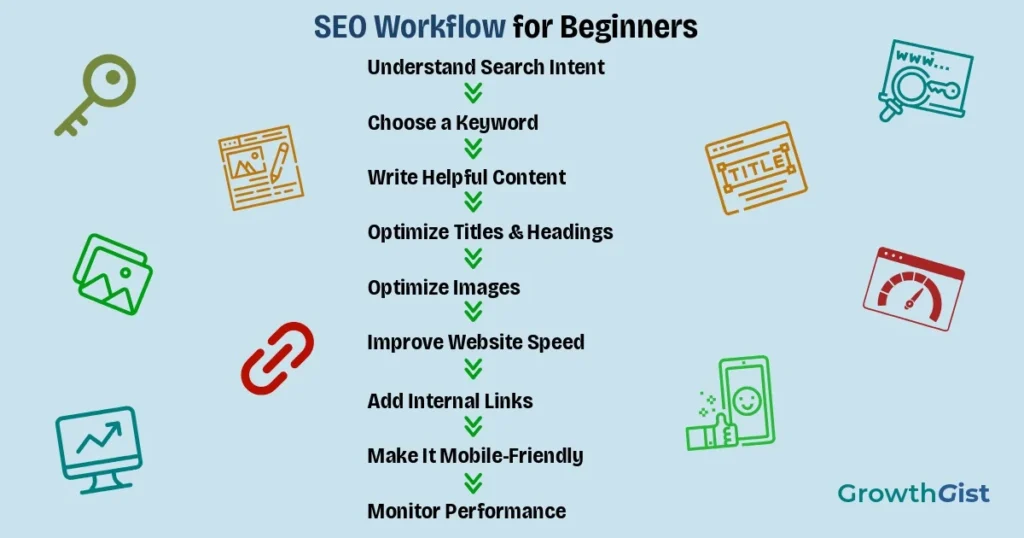
Understand Search Intent
Before creating content, it is important to understand what users are looking for when they search for a keyword.
For instance, someone searching for “best smartphones under 20,000 Rs.” is seeking recommendations, while someone searching for “how to clean a smartphone screen” is looking for instructions.
Meanwhile, another user might want to discover the “best accessories for smartphones.”
Based on this, create content that aligns with the searcher’s intent.
Creating content that matches search intent improves the chances of satisfying users’ expectations. When visitors quickly find the information they need, they are more likely to stay on your page, explore additional content, and return in the future. Understanding intent before writing also helps you choose the right format, whether it’s a guide, comparison, tutorial, or product review.
Focus on Keywords
Keyword research helps you discover the terms people are searching for.
Use tools such as Google Keyword Planner, Google Search suggestions, and SEO tools to find relevant keywords with reasonable search volume and competition.
Target one primary keyword for each article.
Before selecting a keyword, analyze the top-ranking pages for that topic. This can help you understand the type of content users expect and the level of competition you may face.
Long-tail keywords often have lower competition and can be easier for beginners to rank for compared to broad keywords.
For example, instead of targeting a broad keyword like SEO, a beginner may find it easier to rank for a more specific phrase such as SEO tips for beginners or how to improve website SEO. Specific keywords often attract visitors who are looking for clear answers, making them valuable for new websites.
Write High-Quality Content: A Key Part of 10 SEO Tips for Beginners
Google prioritizes useful and informative content.
Focus on solving problems, answering questions, and providing accurate information. Avoid publishing thin or low-value articles.
Regularly update your content to keep it accurate and relevant. Fresh and well-maintained content can improve user engagement and search visibility over time.
Before publishing an article, ask yourself whether it answers the reader’s main question completely. Adding practical examples, clear explanations, images, or step-by-step instructions can make your content more useful and encourage visitors to spend more time on your page.
Optimize Your Title Tags
Your title is one of the first things users see in search results. Include your target keyword naturally and make the title compelling enough to encourage clicks.
Example:
10 SEO Tips for Beginners in 2026
Keep your title clear and concise. A good title should accurately describe the content while encouraging users to click on your page in search results.
Avoid misleading or overly sensational titles that don’t match the actual content. A descriptive title builds trust with readers and helps search engines understand what your page is about. Including your primary keyword naturally near the beginning of the title can also improve relevance.
Use Proper Heading Structure for SEO
Organize content using headings.
- H1 for the main title
- H2 for major sections
- H3 for subtopics
A clear heading structure improves readability and helps search engines understand your content.
Well-organized headings also make it easier for visitors to scan your content and quickly find the information they’re looking for. Instead of writing long blocks of text, divide your content into logical sections that guide readers through the topic step by step.
Optimize Images
Compress images to improve page speed.
Use descriptive file names and add relevant alt text to help search engines understand the image content.
Large image files can slow down your website. Compressing images before uploading them helps improve loading speed without significantly affecting quality.
Choose image file names that describe the content instead of using generic names such as IMG1234.jpg. Adding meaningful alt text not only helps search engines understand your images but also improves accessibility for users who rely on screen readers.
Improve Website Speed
A slow website can negatively impact user experience and rankings.
Use caching, optimized images, and quality hosting to improve loading times.
Fast-loading websites provide a better user experience and often achieve lower bounce rates. Regularly test your site’s speed and address any performance issues.
Even small improvements, such as reducing unnecessary plugins, enabling browser caching, and optimizing images, can make your website load faster. Faster websites generally provide a smoother experience for visitors and encourage them to stay longer.
Build Internal Links for Better SEO
Link to related articles within your website.
Internal links help visitors discover more content and assist search engines in understanding your site’s structure.
Linking to relevant articles also encourages users to spend more time on your website. This can improve engagement and make your content easier to navigate.
When adding internal links, connect pages that are genuinely related to the topic. Natural internal linking helps readers continue learning while also helping search engines understand the relationships between different pages on your website.
Make Your Website Mobile-Friendly
Most internet users browse on mobile devices.
Ensure your website is responsive and provides a good experience on smartphones and tablets.
Check how your website appears on different screen sizes. Mobile-friendly websites are more likely to retain visitors and perform well in search results.
Make sure buttons are easy to tap, text is readable without zooming, and images adjust correctly on smaller screens. Since a large percentage of web traffic comes from mobile devices, a positive mobile experience is essential for both users and search engines.
Monitor Performance When Applying 10 SEO Tips for Beginners
Track your website’s performance using Google Search Console and Google Analytics.
These tools help you identify traffic trends, keyword rankings, and technical issues.
Reviewing your website data regularly allows you to make informed decisions and improve your SEO strategy. Small adjustments based on real data can lead to significant improvements over time.
Monitoring your website regularly helps you understand which pages attract visitors, which keywords generate impressions, and where improvements are needed. Reviewing this information allows you to refine your SEO strategy based on actual performance rather than assumptions.
💡 Key Takeaway
Many beginners try to apply every SEO strategy immediately. Instead, focus on mastering one SEO practice at a time, measure the results, and gradually build your knowledge. Consistency is far more effective than making too many changes at once.
Why These 10 SEO Tips for Beginners Matter
Applying these SEO tips consistently can help you create a website that is both user-friendly and search engine-friendly. Instead of relying on shortcuts or quick fixes, these practices focus on building a strong foundation that supports sustainable long-term growth.
As your website grows, these SEO fundamentals continue to play an important role. Publishing valuable content, improving user experience, optimizing technical elements, and monitoring SEO performance regularly can help your pages become more competitive in search results over time.
Rather than trying to master every SEO technique at once, focus on implementing one improvement at a time. Small, consistent changes can have a significant impact on your website’s visibility, organic traffic, and overall SEO success.
Beginner SEO Checklist
Before publishing your next article, review this quick SEO checklist:
- ✅ Identify the search intent.
- ✅ Choose one primary keyword.
- ✅ Write helpful, original content.
- ✅ Optimize the title tag.
- ✅ Use a proper heading structure.
- ✅ Add descriptive image alt text.
- ✅ Improve page speed.
- ✅ Include relevant internal links.
- ✅ Ensure the page is mobile-friendly.
- ✅ Review performance using Google Search Console.
Final Thoughts
SEO does not produce results overnight, but consistent effort can lead to significant long-term growth. By understanding search intent, performing keyword research, creating quality content, and optimizing your website, you can build a strong foundation for success.
Simultaneously, it becomes essential to utilize the proper heading structure, optimize images, enhance website speed, ensure responsiveness across various platforms, and continuously monitor performance.
It is also important to remember that SEO is an ongoing process rather than a one-time task. Search engine algorithms change regularly, and user behavior evolves over time. By consistently creating valuable content, monitoring performance, and improving your website, you can steadily increase your chances of achieving better rankings and attracting more visitors.
You don’t need to master every SEO technique at once. Focus on applying these ten fundamentals consistently, measure your progress, and keep improving over time.

GrowthGist was founded by Ishwar Solanki to provide clear, practical, and beginner-friendly content on SEO, blogging, AI tools, productivity, website optimization, and digital growth. The platform helps readers build valuable digital skills and strengthen their online presence through actionable insights and reliable information.