

Have you ever wondered why some webpages appear in Google Search quickly while others take much longer to get indexed? Even after publishing quality content, you may notice that certain pages aren’t discovered or updated as fast as expected. One factor that can influence this process is crawl budget.
Crawl budget refers to the number of pages search engines are willing and able to crawl on your website within a certain period. For small websites, crawl budget is usually not a major concern. However, as your website grows, understanding how search engines crawl your pages can help you manage your site more efficiently.
In this beginner-friendly guide, you’ll learn what crawl budget is, why it matters, how it works, the factors that affect it, common mistakes to avoid, and the best practices for improving your website’s crawl efficiency.
What Is Crawl Budget?
Crawl budget is the number of URLs a search engine is likely to crawl and process on your website during a given period.
Search engines use automated programs, often called crawlers or bots, to discover new pages and revisit existing ones. Since they cannot spend unlimited resources crawling every website, they decide how many pages to crawl based on several factors.
Google explains how crawling works in its official Google Search Central crawling documentation.
A healthy crawl budget helps search engines discover important pages more efficiently, especially on websites with a large number of URLs.
Why Is Crawl Budget Important?
Every website wants its important pages to be discovered, indexed, and updated regularly. If search engines spend too much time crawling unnecessary or duplicate pages, they may delay crawling pages that actually matter.
An optimized crawl budget can help:
- Improve crawling efficiency.
- Help search engines discover new content faster.
- Reduce unnecessary crawling of low-value pages.
- Improve indexing of important pages.
- Support better website maintenance.
- Make website resources easier to manage.
Although it isn’t a major ranking factor for most small websites, understanding it becomes increasingly valuable as your website expands.
⚠️ Common Mistake
Many beginners assume that once a page is published, search engines will discover it immediately. In reality, crawling happens over time, and different pages may be revisited at different intervals. That’s why some pages are indexed faster than others.
How Does Crawl Budget Work?
Search engines decide how much of your website to crawl based on their own systems and priorities.
In simple terms, the process usually works like this:
- Search engines discover your website.
- Crawlers begin visiting your pages.
- They evaluate which pages deserve regular crawling.
- Important pages are revisited over time.
- New or updated content is discovered during future crawls.
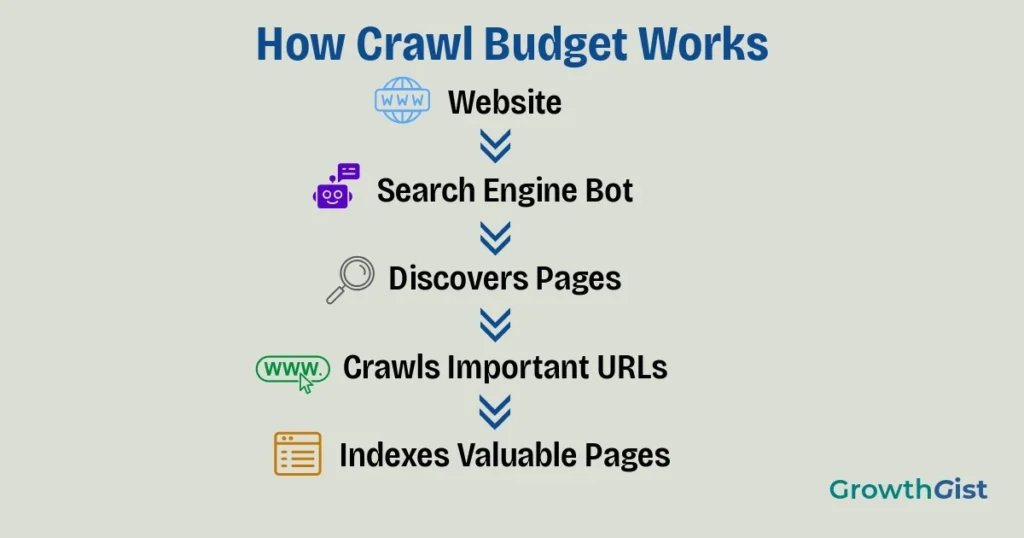
The goal is to use crawling resources efficiently while keeping search results as up to date as possible.
What Affects Crawl Budget?
Several factors can influence how search engines allocate crawl resources to your website.
Some of the most common factors include:
- Website size.
- Website speed.
- Server reliability.
- Internal linking structure.
- Duplicate pages.
- Broken links.
- Redirect chains.
- Crawl errors.
- Frequently updated content.
Website performance improvements, including Core Web Vitals, can also support a healthier technical foundation.
Improving these areas can make it easier for search engines to crawl your website effectively.
Does Every Website Need to Worry About Crawl Budget?
For most beginners, the answer is no.
Small websites with a limited number of pages usually don’t experience crawl budget problems because search engines can crawl them without difficulty.
Crawl budget becomes more important for websites that have:
- Thousands of pages.
- Large eCommerce stores.
- News websites.
- Frequently updated content.
- Many duplicate or low-value pages.
Using canonical tags correctly can reduce unnecessary crawling of duplicate or very similar pages.
If your website has only a few dozen or even a few hundred well-organized pages, crawl budget is unlikely to become a limiting factor. Building helpful content and maintaining a clean website will usually have a much greater impact than trying to optimize crawl budget too early.
As your website grows, crawl budget naturally becomes a more important part of your overall SEO strategy.
How to Improve Crawl Budget
While you cannot directly control crawl budget, you can make your website easier for search engines to crawl.
Some practical ways include:
- Publish valuable content regularly.
- Fix broken links.
- Reduce duplicate pages.
- Improve website speed.
- Keep your XML sitemap updated.
- Use a logical website structure.
- Maintain clear internal linking.
- Monitor crawl issues in Google Search Console.
These improvements help search engines spend more time crawling pages that provide value to users.
Best Practices for Crawl Budget Optimization
Following good website management practices naturally supports efficient crawling.
Some recommendations include:
- Keep important pages easy to reach.
- Remove unnecessary redirect chains.
- Avoid creating large numbers of low-value URLs.
- Update outdated content when necessary.
- Monitor website health regularly.
- Resolve crawl errors promptly.
Along with efficient crawling, implementing structured data can help search engines better understand your content.
Rather than trying to increase crawl budget, focus on making better use of the crawl resources your website already receives.
Common Crawl Budget Mistakes
Many crawl budget issues result from poor website management rather than the crawl budget itself.
Some common mistakes include:
- Publishing large amounts of duplicate content.
- Leaving broken links unresolved.
- Creating unnecessary redirect chains.
- Blocking important pages accidentally.
- Ignoring crawl errors.
- Allowing outdated pages to accumulate without review.
Regular website maintenance helps prevent these problems from affecting search engine crawling.
How to Check Crawl Activity
If you want to understand how search engines crawl your website, several tools can help.
You can monitor crawl activity by:
- Reviewing reports in Google Search Console.
- Checking crawl statistics where available.
- Using SEO auditing tools.
- Monitoring server logs (for advanced users).
- Reviewing indexing reports regularly.
Checking crawl activity occasionally helps you identify technical issues before they become larger problems.
Monitoring crawl activity doesn’t need to become part of your daily routine. Reviewing your reports from time to time is usually enough to identify important crawling or indexing issues before they affect a larger number of pages.
Final Thoughts
Crawl budget refers to the amount of crawling activity search engines allocate to your website over time. While most beginners don’t need to worry about it immediately, understanding the concept becomes increasingly useful as your website grows.
Instead of trying to manipulate crawl budget directly, focus on creating valuable content, maintaining a clean website structure, fixing technical SEO issues, and helping search engines discover your important pages efficiently. These long-term practices support better crawling, improved indexing, and a stronger foundation for your website’s overall SEO.

GrowthGist was founded by Ishwar Solanki to provide clear, practical, and beginner-friendly content on SEO, blogging, AI tools, productivity, website optimization, and digital growth. The platform helps readers build valuable digital skills and strengthen their online presence through actionable insights and reliable information.