

If you’ve ever noticed search results displaying star ratings, FAQs, product prices, recipes, or business details, you’ve already seen structured data in action. It helps search engines understand your content more accurately and present it in more useful ways.
While this markup is not a direct ranking factor, it is an important part of technical SEO because it improves how search engines understand and present your content. When combined with a strong SEO strategy, it can increase your chances of appearing as rich results in Google Search.
In this beginner-friendly guide, you’ll learn what structured data and schema markup are, why they matter, how they work, the most common schema types, and the best practices for implementing them correctly.
What Is Structured Data?
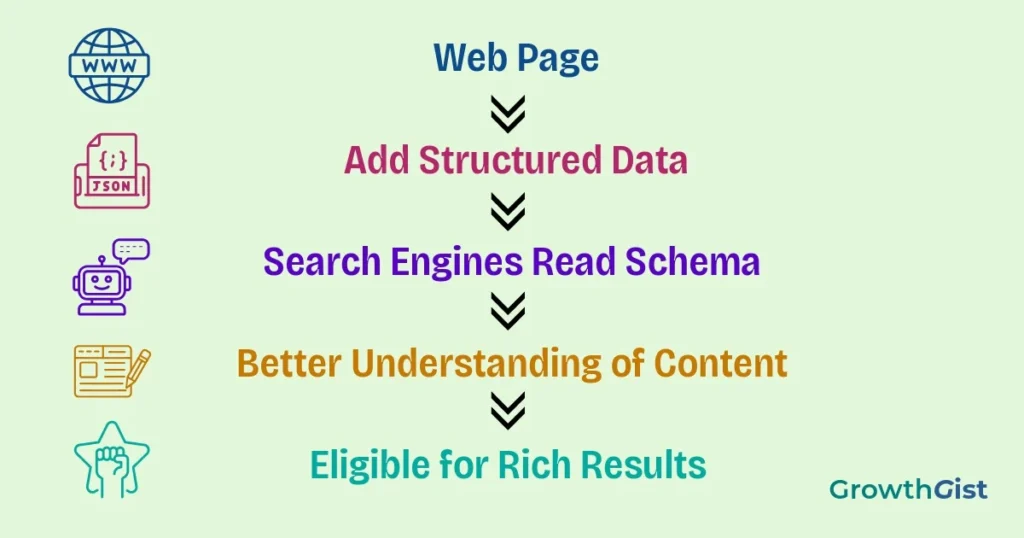
Structured data is a standardized format used to organize information on a webpage so that search engines can understand its meaning more clearly.
Instead of relying only on the visible text, structured markup provides additional details about your content, such as whether a page is an article, product, recipe, event, organization, or local business.
Think of structured data as labels that help search engines identify information such as authors, publication dates, product prices, business details, FAQs, and customer ratings.
Understanding how search engines work makes it easier to see why structured data plays an important role in helping them organize and display information accurately.
What Is Schema Markup?
Schema markup is the actual code added to a webpage that provides structured data.
Schema markup is the code that implements structured data using the Schema.org vocabulary, allowing search engines to understand different types of content.
You can explore the complete schema vocabulary on the official Schema.org website.
Most modern SEO plugins automatically generate schema markup for common content types, so beginners usually don’t need to write code manually.
Why Is Structured Data Important?
Structured data offers benefits beyond helping search engines understand your content.
When implemented correctly, it can improve how your pages appear in search results by providing additional information directly to users.
Some of its key benefits include:
- Helps search engines understand page content.
- Makes pages eligible for rich results.
- Improves search result appearance.
- Supports better user experience.
Although It does not guarantee higher rankings, it complements other optimization efforts such as meta titles and descriptions, quality content, and overall website optimization.
Many beginners overlook It because it isn’t visible to website visitors. However, search engines rely on this additional information to better understand your content. Adding the right schema from the beginning can make your website more organized as it continues to grow.
How Does Structured Data Work?
The process is relatively straightforward.
After publishing a webpage, search engines crawl its content and analyze both the visible information and any structured data available.
A simplified process looks like this:
- Create high-quality content.
- Add the appropriate schema markup.
- Search engines crawl the webpage.
- Structured data is processed and interpreted.
- The page may become eligible for rich results.
Eligibility does not guarantee that Google will display rich results. Search engines evaluate many factors before deciding how a page appears in search results.
Common Types of Schema Markup
You don’t need to implement every schema type on your website. Instead, choose the one that best matches your content.
Below are some of the most commonly used schema types for beginners.
Article Schema
Article schema is used for blog posts, tutorials, news articles, and educational content. It helps search engines understand details such as the article title, author, publication date, and featured image. Many SEO plugins automatically generate this schema for WordPress websites.
Organization Schema
Organization schema identifies the business or organization behind a website. It can include details such as the organization name, logo, website, contact information, and social profiles.
This helps search engines better identify the organization behind your website and maintain consistent information across different Google services.
Breadcrumb Schema
Breadcrumb schema helps search engines understand the relationship between pages on your website. It shows the path users follow while navigating through different sections of your site. This can improve navigation for visitors and help search engines better interpret your website structure.
Local Business Schema
Local Business schema is designed for businesses that serve customers in a specific geographic area. It can include information such as: business name, address, phone number, opening hours, website and business category
🚀 Quick Tip
Start with the schema type that matches your most important pages first. Once you’re confident it’s implemented correctly, you can gradually add schema to the rest of your website.
Product Schema
Product schema is commonly used by eCommerce websites.
It can include product name, price, availability, brand, ratings, and reviews to help search engines understand product information.
FAQ Schema
FAQ schema is suitable for pages containing genuine questions and answers.
Each question should have a clear, helpful answer that is also visible on the webpage. Avoid adding FAQ schema to content that doesn’t actually contain an FAQ section, as the markup should always reflect the visible content.
How to Add Structured Data
Google recommends using JSON-LD, which is easier to maintain than older formats such as Microdata and RDFa. Most WordPress SEO plugins automatically generate JSON-LD, so beginners usually don’t need to write code manually.
Google’s structured data guidelines explain how to implement structured data and supported rich results.
If you’re using WordPress, you usually don’t need to write schema markup manually.
A typical implementation process looks like this:
- Choose the correct schema type for your page.
- Add or verify the schema using your SEO plugin.
- Complete any required information.
- Publish or update the page.
- Test the structured data before making it live.
Taking a few extra minutes to verify your schema helps prevent errors that could affect how search engines interpret your content.
If you’re using an SEO plugin, implementing schema is often much simpler than it sounds. Instead of focusing on the code itself, choose the correct schema type and ensure the information accurately reflects the content on the page.
Test Your Structured Data
After implementing schema markup, always test it before considering the job complete.
Validation helps identify:
- Missing required properties
- Invalid values
- Warnings
- Errors
- Unsupported fields
You can also monitor structured data issues through Google Search Console, which reports enhancements, warnings, and indexing-related information for eligible schema types.
Regularly checking your structured data should become part of every SEO audit, especially after redesigning your website or making significant content updates.
Best Practices for Structured Data
Following a few best practices helps ensure your structured data remains useful and accurate.
Some recommendations include:
- Use the correct schema type.
- Match schema with visible content.
- Validate before publishing.
- Update schema whenever content changes.
Structured data should accurately describe your content, not attempt to manipulate search results. Even with perfect schema implementation, high-quality content remains the foundation of effective SEO.
Common Structured Data Mistakes
Many beginners make similar mistakes when adding schema markup.
Some of the most common include:
- Using the wrong schema.
- Adding inaccurate information.
- Ignoring validation errors.
- Expecting instant rich results.
Another common mistake is assuming that it alone improves rankings. In reality, it works alongside other optimization efforts such as Core Web Vitals, content quality, and a well-structured website.
Learning the markup doesn’t require mastering every schema type at once. Start with the markup that matches your content, validate it regularly, and improve it as your website expands. A gradual approach is easier to manage and helps avoid unnecessary mistakes.
Final Thoughts
Structured data and schema markup help search engines understand your content more accurately, making it easier to present relevant information in search results.
Combining structured data with a well-maintained XML sitemap helps search engines discover and understand your content more effectively.
Although adding schema doesn’t guarantee rich results or higher rankings, Tracking important SEO metrics helps measure the long-term impact of your optimization efforts.
As search continues to evolve toward understanding topics, relationships, and entities instead of just keywords, schema is becoming increasingly valuable. Learning it now will also prepare you for the future of SEO and provide a stronger foundation as you continue following your complete SEO learning roadmap.

GrowthGist was founded by Ishwar Solanki to provide clear, practical, and beginner-friendly content on SEO, blogging, AI tools, productivity, website optimization, and digital growth. The platform helps readers build valuable digital skills and strengthen their online presence through actionable insights and reliable information.