
SEO mistakes are common when you’re learning how to optimize a website. Some can make your content harder for search engines to understand, while others can create a poor experience for visitors.
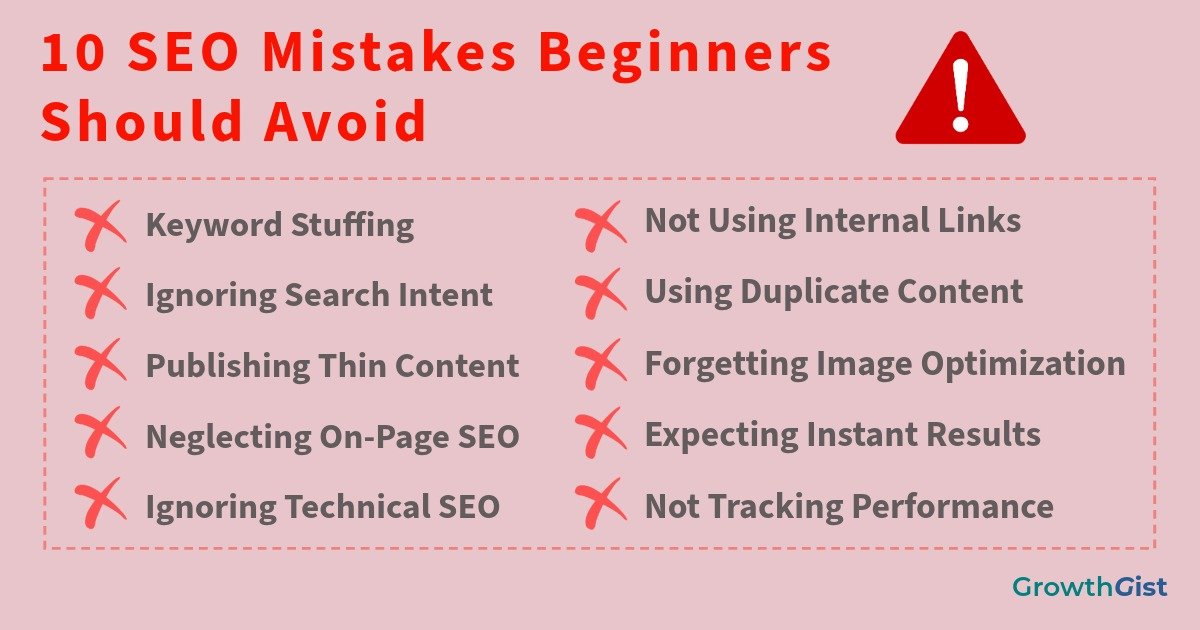
In this guide, we’ll cover 10 common SEO mistakes beginners should avoid and explain simple ways to fix them. These include keyword stuffing, ignoring search intent, thin content, poor on-page SEO, technical issues, weak internal linking, duplicate content, image optimization problems, unrealistic expectations, and failing to track performance.
Why Avoiding SEO Mistakes Matters
SEO is a long-term process that requires consistency and attention to detail. Small mistakes can negatively affect your website rankings, organic traffic, and overall user experience.
Understanding the common SEO mistakes beginners should avoid is essential for building a strong foundation in search engine optimization. While SEO can help improve visibility and organic traffic, certain mistakes can slow progress and prevent your content from reaching its full potential. By recognizing and avoiding these errors, you can improve rankings, enhance user experience, and achieve better long-term results.
According to Google Search Central, creating helpful and user-focused content is one of the most important aspects of SEO.
Common SEO Mistakes Beginners Should Avoid
Learning the SEO mistakes beginners should avoid is one of the fastest ways to improve rankings and create a better experience for visitors. Below are the most common SEO mistakes beginners should avoid when building and optimizing a website.
1. Keyword Stuffing
One of the most common beginner mistakes is keyword stuffing.
Keyword stuffing occurs when a keyword is repeated excessively in an attempt to rank higher in search results.
For example, writing:
“SEO tips for beginners are important because these SEO tips help beginners learn SEO tips.”
Repeating a keyword this way makes the content harder to read and does not make it more useful to search engines or readers. The problem isn’t using a keyword several times; the problem is unnatural, excessive repetition that makes the content harder to read.
Instead, use keywords naturally where it makes sense, and focus on explaining the topic clearly rather than trying to reach a specific keyword count. Use related words and natural variations when appropriate.
For example, instead of repeatedly using “SEO tips,” you could naturally discuss SEO techniques, optimization strategies, search visibility, and practical SEO advice where they fit the context.
2. Ignoring Search Intent
Search intent is the reason behind a user’s search. When your content does not match what people are actually looking for, it may struggle to perform well even if you use the right keywords.
For example, someone searching for “what is SEO” is usually looking for a clear explanation of SEO. Showing them a service page or a product page would not satisfy the same need.
Before creating content, consider what type of result would best answer the search:
| Search query | Likely intent | Suitable content |
|---|---|---|
| What is SEO? | Informational | Beginner guide |
| SEO tools | Investigation | Tools comparison |
| Buy SEO software | Transactional | Product/service page |
Creating content that satisfies user needs improves engagement and increases the likelihood of ranking higher in search results.
3. Publishing Thin Content
Thin content provides little useful information or does not fully satisfy what the reader is looking for. A short article is not automatically thin content—the important question is whether it adequately answers the user’s query.
For example, a 300-word article can be useful if it completely answers a simple question, while a 1,500-word article can still be thin if it contains unnecessary filler and leaves important questions unanswered.
Focus on creating detailed, informative, and original content that covers the topic effectively. Include useful examples where appropriate, and remove information that does not help the reader.
Quality content remains one of the most important factors in modern SEO.
4. Neglecting On-Page SEO
Many beginners overlook important on-page SEO elements.
On-page SEO involves optimizing the elements on a webpage that help search engines understand its topic and help readers navigate the content.
Before publishing, check that your page has a clear title, logical headings, a descriptive URL, useful internal links, and relevant image alt text.
Beginners sometimes focus heavily on keywords while overlooking other important elements. Write the content primarily for readers and use keywords naturally where they fit.
5. Ignoring Technical SEO
Technical SEO helps search engines crawl, understand, and index your website properly. Beginners may overlook technical issues because they are less visible than content and keywords.
Common areas include website speed, mobile usability, HTTPS, XML sitemaps, and crawlability.
Start with the basics. Make sure your website works well on mobile devices, uses HTTPS, loads reasonably quickly, and has an accessible sitemap. Also check that important pages are not accidentally blocked from search engines.
You don’t need to master every technical SEO concept at once. Focus on the issues that can prevent search engines or users from accessing your content properly.
6. Not Using Internal Links
Internal links connect related pages on your website and help readers discover useful information. They can also help search engines understand the relationship between different pages on your site.
A common mistake is either using too few internal links or adding links that have little connection to the topic.
Add an internal link when another page provides useful information that naturally expands on the current topic. Use descriptive anchor text that tells readers what they will find after clicking the link.
For example, an article about SEO mistakes can naturally link to a detailed guide about internal linking when discussing how to connect related pages.
7. Using Duplicate Content
Duplicate content occurs when substantially similar or identical content appears on multiple URLs. It can make it harder for search engines to determine which version is the most appropriate to show in search results.
This does not mean that every repeated phrase or common piece of information is a problem. Websites can naturally have some similar content, especially when products, categories, or other pages share information.
Create original content for important pages and avoid publishing multiple pages that provide essentially the same information. When similar pages are necessary, canonical tags can help search engines understand which version should be considered the main one.
8. Forgetting Image Optimization
Images can improve a page by making content easier to understand, but poorly optimized images can also affect website performance and accessibility. Beginners often upload unnecessarily large files or overlook descriptive filenames and alt text.
Resize images to an appropriate display size, compress them before uploading, and use a suitable format such as WebP when appropriate. Give important images descriptive filenames and write useful alt text when the image conveys information that readers need.
For example, instead of uploading a file named IMG1234.jpg, use a descriptive filename such as seo-dashboard-guide.webp.
9. Expecting Instant Results
SEO usually takes time, and there is no fixed period in which a page will reach a particular position. Beginners may become discouraged when their rankings or traffic do not improve immediately after publishing or updating content.
Search engines need time to crawl, understand, and evaluate pages, while rankings can also change as competition and search results change.
Focus on creating useful content, improving your website based on real performance data, and making changes consistently rather than expecting immediate results. A clear SEO strategy can help you prioritize these efforts and work toward long-term growth.
10. Not Tracking Performance
Publishing content without checking how it performs makes it difficult to know what is working and what needs improvement. Beginners may focus only on rankings, while other useful signals can show how people are discovering and interacting with their content.
Regularly monitor important SEO metrics such as impressions, clicks, click-through rate (CTR), and average position. Google Search Console can show which search queries generate impressions and clicks, while analytics tools can provide additional information about visitors and their behavior.
Use this information to identify pages that are performing well and those that may benefit from further improvement. SEO is an ongoing process, so reviewing performance can help you make more informed decisions over time.
How to Fix These SEO Mistakes
You don’t need to fix every SEO issue at once. Start with the problems that have the biggest impact on your website and improve them gradually.
Before publishing or updating a page, use this quick checklist:
- Use keywords naturally.
- Focus on search intent.
- Create helpful, relevant content.
- Improve on-page SEO elements.
- Monitor technical SEO issues.
- Add internal links where relevant.
- Optimize images.
- Track performance regularly.
- Be patient with results.
💡 Key Takeaway
SEO is not about doing everything perfectly—it is about consistently removing problems that make your content less useful to readers or harder for search engines to understand.
Final Thoughts
Avoiding common SEO mistakes can help you build a stronger website and make your optimization efforts more effective. You don’t need to get everything right from the beginning. Focus on creating helpful content, understanding what your audience is looking for, and providing a good experience for visitors.
As your website grows, use performance data to identify what is working and where improvements are needed. SEO is an ongoing process, so patience, consistency, and continuous learning can help you improve your search visibility and build sustainable organic traffic over time.

GrowthGist was founded by Ishwar Solanki to provide clear, practical, and beginner-friendly content on SEO, blogging, AI tools, productivity, website optimization, and digital growth. The platform helps readers build valuable digital skills and strengthen their online presence through actionable insights and reliable information.